
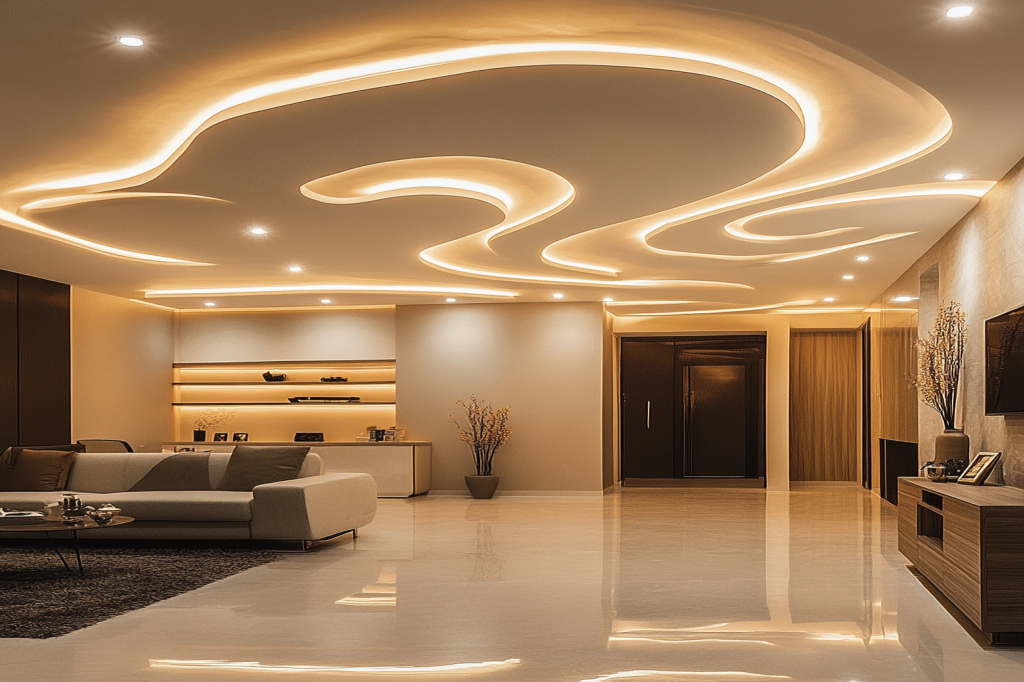
A false ceiling is one of the fastest ways to make a home look "designed." It's also one of the easiest line items for a budget to quietly run away from you. Ask any mid-sized design studio in Gurgaon, Noida, or Delhi how a client's ceiling budget doubled mid-project, and the answer is rarely the gypsum board itself — it's everything the ceiling drags along with it.
If you're pricing a gypsum false ceiling cost per sq ft in Gurgaon for a client right now, this guide breaks down exactly where the money goes, what a realistic 2BHK budget looks like across three design tiers, and how to design a ceiling that keeps its visual impact without becoming a budget-eater.
The Compound Cost Trap: It's Never Just the Gypsum Board
Here's the trap that catches even experienced designers: a false ceiling quote that only accounts for gypsum board and framing is incomplete by definition. A full designer ceiling compounds cost across at least three separate trades, and each one scales with how extensive the ceiling design is:
- Electrical conduit rerouting — Every cove, every recessed spotlight, and every ceiling fan relocation means additional conduit runs above the false ceiling line. More layers and more light points mean more wiring points, more junction boxes, and more electrician hours — before a single gypsum sheet goes up.
- Light fixture costs — A plain ceiling might need one central light. A layered cove ceiling can call for 8–15 recessed spots plus LED strip lighting for the cove itself. Fixture cost, driver units, and dimmer wiring all scale with ceiling complexity, not floor area.
- Ceiling painting costs — Every additional layer, step, and cove edge adds surface area and cutting-in labor for painters. A single-level ceiling might take a painting crew half a day; a multi-layer designer ceiling with distinct color zones can take two to three times as long.
This is why two ceilings covering the same square footage can differ in final cost by 3–4x. The gypsum board itself is rarely more than 25–30% of the total false ceiling budget once electrical and painting are factored in — the design complexity is what you're really pricing.
2BHK False Ceiling Budget Breakdown (2026)
Use these as planning benchmarks for a standard 2BHK across living, dining, and bedroom areas:
| TierScopeTypical Cost (2BHK) | ||
| Basic | Standard gypsum board, partial coverage (living room only, simple perimeter drop) | ₹60,000 – ₹1,00,000 |
| Mid-Range | Full layered layouts with warm cove lighting across living/dining | ₹1,20,000 – ₹2,00,000 |
| Premium | Designer wooden accents, custom metal frame detailing, multi-zone lighting | ₹2,50,000 – ₹4,50,000 |
Basic ceilings are typically restricted to the living area, using a single perimeter drop with standard gypsum board and minimal cove detailing — enough to hide wiring and add a clean edge without heavy electrical rework.
Mid-range ceilings are where most NCR clients actually land: full layered gypsum work with warm cove lighting running across the living and dining zones, giving the "designed" look without extending into every bedroom.
Premium ceilings introduce wooden slat accents, custom fabricated metal frames, and multi-zone lighting control — this tier is where electrical and fixture costs start to rival, or even exceed, the gypsum and labor cost itself.
POP vs. Gypsum vs. Grid: What Actually Changes the Price
Designers and homeowners often use "false ceiling" as a catch-all term, but the underlying system changes both cost and capability significantly.
- POP (Plaster of Paris) — The traditional choice for ornate cornices and decorative molding. POP is cheaper per running foot for cornice work but requires skilled on-site plastering labor, has a longer curing and finishing timeline, and is less forgiving of humidity compared to gypsum.
- Gypsum Board — The current NCR standard for layered, cove-lit designer ceilings. Gypsum board is factory-finished, faster to install, and gives cleaner geometric lines for cove and step designs — which is why it dominates mid-range and premium quotes today.
- Grid (Channel/Suspension) Systems — Typically used in utility areas, kitchens, or false ceilings that need to be removable for maintenance access (above modular kitchens, near AC ducting). Grid systems are the most economical per square foot but offer the least design flexibility — no coves, no curved edges, no integrated cove lighting.
The Smart Budget Move: Selective Coving, Not Universal Dropping
One of the most effective ways to protect a ceiling budget without losing the design impact: restrict layered, cove-lit ceilings to the living area only, and keep bedrooms plain or minimally dropped.
A cove-only treatment in the living room delivers the visual "wow" that clients associate with a designed home — warm light washing along a ceiling edge, a clean perimeter line — at a fraction of the cost of extending that same treatment into every bedroom. Bedrooms rarely need dramatic ceiling lighting; a plain or single-step ceiling with good ambient lighting achieves the comfort factor homeowners actually want at night, without the electrical and painting costs of a full layered design.
This single decision — cove living room, plain bedrooms — is often the difference between a mid-range budget and a premium one, for a design that still "reads" as fully custom.
NCR Rate Checklist: Per-Sq-Ft Labor Charges in Noida & Gurgaon
When reviewing a contractor's quote, check labor rates against these standard NCR ranges:
- POP cornice work — priced per running foot rather than per sq ft; rates vary by cornice width and design complexity, and skilled POP labor is increasingly scarce in NCR, which is pushing rates upward year over year.
- Gypsum board hanging — priced per sq ft of ceiling area, varying with the number of layers and cove details; a single-layer flat ceiling costs meaningfully less per sq ft than a multi-step layered design.
- Channel/grid suspension — generally the lowest per-sq-ft labor cost of the three systems, reflecting its simpler, non-decorative installation.
Because these rates fluctuate with material costs, contractor availability, and project scale, always request a line-itemized quote separating board cost, framing/channel cost, and labor — rather than a single blended per-sq-ft number. A blended rate makes it nearly impossible to spot where a contractor is overcharging or underscoping the electrical work.
Get the Delhi-NCR GFC Technical Drawing Checklist
🔧 Coming Soon: Interactive Delhi-NCR GFC (Good For Construction) Technical Drawing Checklist Cross-check your electrical routing diagrams against your ceiling plan layer-by-layer — so light points, conduit runs, and cove details are locked in before the gypsum crew arrives on site. [Join the waitlist →]
A false ceiling budget only stays under control when the electrical drawing and the ceiling plan are designed together, not handed to two different contractors working from two different sketches. This checklist is built specifically for that handoff point — the one place most NCR ceiling budgets quietly blow out.
Rates reflect general Gurgaon, Noida, and Delhi market ranges for 2026 and vary by vendor, site condition, and design complexity. Always confirm current per-sq-ft labor rates with your ceiling contractor before finalizing a client quote.